
Best wishes. I hope you find the right career for you.
Best wishes. I hope you find the right career for you.
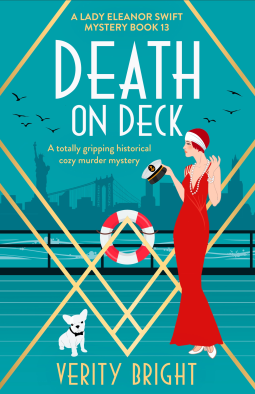
Thank you "Verity Bright" for bringing me a much-needed escape from today's scary and heartbreaking headlines. And on this luxury cruise, with a fun and witty companion, it was an escape in style. So thank you to NetGalley and Bookouture for this advanced reader copy. I'm new to this writer and series, but I've already searched out book one in this series, and I intend to read it when I finish the books on my current reading list.
This was fun from the beginning, and it kept me very engaged until about halfway through. At that point, I wondered if I could finish. I am easily bored, and the elaborate descriptions of food and ship went a little "overboard" for me. After halfway, it just became a matter of wanting to know the ending even though my attention was drifting a little.
There were some questions along the way. The biggest one was when Eleanor threw open a porthole window to gulp some salty sea air. I thought portholes didn't open on ships because of the danger of flooding. Can't have the ships sinking. That took me out of the story and sent me to Google. I'm still unclear as to whether portholes open or not. Some say yes. Some say no. I just don't think that anything that kicks the reader out of a story is a good thing. That scene wasn't really necessary anyway, and a temporary loss of a reader isn't good. It was a few hours before I resumed reading. (The question became more important later on.)
I also questioned how someone can "nod vociferously" or just bow from the shoulders.
Even though it became cumbersome, there were some great descriptions of the Celestiana. I loved the gold room with its staircase and model of the solar system and the description of the passing Auriana as a "floating skyscraper." However, it seemed the food was described more often than the ship was. It got to be a little much. Some of it just seemed like filler to make the required word count.
But I did enjoy the story, Eleanor's relationship with Clifford and her staff, and the very likable protagonist. The "Verity Bright" writing team have a great "voice," and I loved the banter between Eleanor and Clifford. I loved the banter. Period. I thought the dialogue was mostly great. I also liked the humor, and this is one of the lines that made me chuckle out loud: "I thought I was expected to languish about elegantly, exerting myself about as much as a dying duck."
Thank you again for an enjoyable cozy. This was a very good mystery. I give it 4.5 stars rounded up to 5.
.jpg) I am running a free promotion for my new novella, Mystery of the Fox Down Dog and Other Stories. The digital version will be free on Thanksgiving Day, November 24, 2022. The digital version will also be free on Christmas Eve and Christmas Day, 2022. I have included the link to the book in this post. It is also available in paperback, and hardcover, but I am not running a promotion for those formats. The link and a
five-star review are also in this post. Thanks!
I am running a free promotion for my new novella, Mystery of the Fox Down Dog and Other Stories. The digital version will be free on Thanksgiving Day, November 24, 2022. The digital version will also be free on Christmas Eve and Christmas Day, 2022. I have included the link to the book in this post. It is also available in paperback, and hardcover, but I am not running a promotion for those formats. The link and a
five-star review are also in this post. Thanks!
Here's the link: https://www.amazon.com/dp/B0BKVCP213
Here is my first review:
5.0 out of 5 stars
Humor and horror in just the right mix
Reviewed in the United States 🇺🇸 on November 5, 2022
"This
is a fun collection! Kennedy writes very well, blending mystery, quirky
humor, crime, and horror in a set of stories with an array of different
characters and settings. In the most chilling story (to me), which felt
rather Stephen King in mood, a ouija-board-like toy does exactly what
we all fear a ouija board might do; while on the other end of the
dark/light spectrum, the funniest story covers a few quick episodes in
the lives of Darrel and Lloyd, muddleheaded criminal disasters. But to
me the standout was the longest story, Mystery of the Fox Down Dog,
in which the role of small-town amateur sleuths is played by an elderly
married couple who happen to be retired CIA agents. Emily and Arthur
are a delight!"
See my previous post for a larger image of my cover. Thanks again!
Here's the link: https://www.amazon.com/dp/B0BKVCP213
Here's my first review: (Actually, it's my only review.)
5.0 out of 5 stars
Humor and horror in just the right mix
Reviewed in the United States 🇺🇸 on November 5, 2022
"This is a fun collection! Kennedy writes very well, blending mystery, quirky humor, crime, and horror in a set of stories with an array of different characters and settings. In the most chilling story (to me), which felt rather Stephen King in mood, a ouija-board-like toy does exactly what we all fear a ouija board might do; while on the other end of the dark/light spectrum, the funniest story covers a few quick episodes in the lives of Darrel and Lloyd, muddleheaded criminal disasters. But to me the standout was the longest story, Mystery of the Fox Down Dog, in which the role of small-town amateur sleuths is played by an elderly married couple who happen to be retired CIA agents. Emily and Arthur are a delight!"
Here's a larger image of my cover:
.jpg)
Here's an excerpt from the fourth story in the novella. This short story is entitled, Night on Big Foot Mountain.
It was a frosty night. Slips of snow eased over the sloped roof and fell with soft, steady plops onto the ground below. Orly waited for some sign, not knowing what it would be, but certain he would recognize it when it came. It could be the hoot of an owl, a light in the woods, or a dark shape along the old farmer’s road.
It came as a soft whistle, forlorn and eerie, easily mimicking the winds that would blow down from the north and hiss through the narrow cracks around his windowsill. But there was no wind tonight. An old floorboard creaked outside his door. Orly held his breath, waiting for more sounds. There was another creak, then another. A door was eased back on rusty hinges, then silence.
He waited until he saw three dark shapes emerge from the shadows and disappear into Sump Woods. They were met by other dark shapes. Orly wrapped his wooly scarf around his head, slung his knapsack over his shoulder, then moved across his room as quietly as his bulk would permit. Orly was a big man, big enough to fight Jack Dempsey according to his papa; but, truth was, he’d rather cut off a finger than lift it against anyone. Quiet reflection was as important to him as the illicit moonshine still in the woods was to his papa and brothers.
You can read a much longer excerpt at Amazon with the "Look Inside" feature. The long excerpt at Amazon is from the title story, Mystery of the Fox Down Dog. Thanks!

Kristine, and Kimber the Magnificent, at Pages & Paws have reviewed Thirteen Miracles and have given it Five Stars! Here is the link to the full review: https://pagesandpaws.com/2020/10/07/thirteen-miracles-my-new-best-bud/
They are my first readers and my first review. (Well, technically, my editor also read it, but she doesn't count. She was working and not what I would call "a reader".)
I am on wings after this review. I didn't know what to expect because some of the reviews at Pages & Paws are a little on the scary side. (Actually, they're a lot on the scary side.) So, for my book to be labeled "a gem" and to get a five-star review from this formidable review site was more than I'd hoped for or expected!
Please visit the blog and check out the review. Here's the link again:
https://pagesandpaws.com/2020/10/07/thirteen-miracles-my-new-best-bud/
Here are some of my favorite bits: Bebo is now Kimber's new best bud. That made me cry all by itself. And Kristine said Thirteen Miracles is "a little Narnia, a little This Present Darkness, a little The Shack, and a bit Hatchet all rolled into one." She also said it "packs a wallop" and that, "There's so much joy and hope in the final pages" that she's thinking of "buying stock in Kleenex!" She called it a "beautifully written story that's warm, invigorating, and maybe even a little bit extraordinary." Called it "nimble, creative, and fresh," and said it was, "brimming with engaging, lively characters who learn and grow. Ditto credible dialogue and enough mystery and intrigue to keep you guessing until the last page." She also gave it a rare 5 stars!! Which, according to her rating system, means: "Superb. Our highest rating. Better than bacon! A remarkable achievement. Must have a transcendent theme. Rings heart bells. May qualify as life-changing. Would read over and over and over."
What writer wouldn't want to get such a review?
It was one exhilarating review, and I am smiling from ear to ear as I read it -- in between sobs of joy! I'll always be grateful to Kimber the Magnificent and the equally Magnificent Kristine.
Wow.
And, on a much lesser note, I have a new cover. I had run some small test ads at BookBub, and my first cover did not do well. My second cover did even worse. This is actually the third cover, and it performed like a champ in a test ad at BookBub.

Thirteen Miracles is now available at Amazon in both digital and print formats.
https://www.amazon.com/dp/B08JDTNSML
It is also available at Barnes and Nobel in paperback and hard cover.
https://www.barnesandnoble.com/w/thirteen-miracles-dl-kennedy/1137716871
Once again, here are the blurbs and an excerpt, as well as the trailer.
Short blurb: A woman's search for God ends in a miraculous rescue mission in
the marijuana fields of the Devil's Backbone.
Here is the longer back-cover blurb:
Legend says it was the landing spot for Lucifer when he was cast out of
heaven. That's not the only thing it's known for. It is also a land of
marijuana fields, opium poppies, kidnappings, and drug-related killings. It's
the last place you would expect to find God, but Abby Welles is looking for
Him there. Her search will lead her on a miraculous rescue mission inside
the heart of The Devil's Backbone.
But she is running out of time, and she may have already run out of luck.
+++
Here is an excerpt:
It was perched on a dead tree overhanging the
mountainside, watching the activity below. Something in the bird’s gaze and
mechanical head movements troubled her. Was it watching the activity or
controlling it? She silently ridiculed the thought. She was being paranoid.
This place did that to her.
The rifle fired, and she jumped. An unexpected
explosion ripped through the early morning quiet.
Scarface gave a sudden shriek of pain and fell to the
ground, clutching his face with blackened and bloodied hands. Unearthly sounds
accompanied his cries and repeated off the wall of rocks. Bebo joined in the
chorus, barking furiously, teeth barred. Abby wanted to silence him but knew
it was pointless. His barks were lost in the sea of strange sounds.
She tugged on him, pulling him back. He had strayed
too close to the edge. Once he was on safer ground, she strained to see where
the other noises were coming from. Had the weapon backfired? Was shrapnel
pinging off rocks? Not that it would explain what she was hearing. These were
more like animal yips and howls, but not quite.
Whatever was producing these noises wasn’t apparent
from her vantage point. Fear gripped her every muscle and nerve as the sounds
continued and grew more bizarre. Surely these weren’t the natural sounds of
nature. They didn’t even seem to originate from anything she could see—or ever
would see—in this world.
+++
Here is the trailer:
Interview Questions: This interview is a combination of questions from the Smashwords Interview feature and a Q&A with my niece.
Describe your desk
I'll paraphrase Zola Levitt. For evidence of the Second Law of Thermodynamics, one need only look at my desk. Everything on it is moving from a state of order to disorder.
When did you first start writing?
In eighth grade. I had an amazing teacher, Mr. McIntyre. He gave us contracts at the start of the year. We decided what grade we wanted to earn. I wanted an "A", but that meant I had to write three short stories. He read those stories out loud to the class. Fortunately, he was an actor, and he did a really good job reading them. The class laughed like crazy and everyone enjoyed my stories. I've been writing ever since.
What do you want readers to know about your Christian book, "Thirteen Miracles"?
There are a lot of layers to "Thirteen Miracles" and a lot of archetypes. For example, I think of Abby's husband, Charles, as a "type" of Christ. He goes into Satan's territory hoping to save his wife. I also want readers to know in advance that this is mostly a story about a woman and a dog in a wilderness survival story. So there is not a lot of dialogue. I think that no matter how many people are with us in this life, we are ultimately alone with God in the wilderness. I want readers to feel they have been inside Abby's head, heart, and soul by the end of this story. But my goal is to tell a good story. I hope I've done that in "Thirteen Miracles."
What is "Thirteen Miracles" about?
It's about a woman's search for God. Abby has gone to Mexico to write a book about miracles and to meet a Christian mystic who has the gift of prophecy. After some family struggles, Abby is reeling. She has lost her faith and feels that she must connect with God again if she is ever going to recover from her depression. She feels that she must get away from the "screaming commitments" in her life in order to do that.
On her journey, she is separated from her guide and must survive on her own with the help of an albino boxer named Bebo. As she attempts to find her way home, she discovers that two sixteen-year-old boys have been kidnapped by drug runners. She decides she must try to free them from their captors, and the book follows her journey inside The Devil's Backbone as she attempts to survive the wilderness and free the hostages, but she has some supernatural resistance to her goal as well as some natural ones.
You have called this a supernatural adventure, is that the best description of your story?
Yes. It is a Christian, supernatural adventure. I also think of "Thirteen Miracles" as a missionary story. As human beings, we have been separated from God and must find our way home. If we do, our goal is then to attempt to rescue others who are being held captive. But, it is an allegorical story in many different ways. It is the reader who will decipher the symbols and decide if they succeed or not. I don't want things to be taken too far, however. It is just a story, after all, with symbolic undertones. Above everything, I want the reader to experience a good story and be impacted by it.
Will this appeal to non-Christians?
Maybe. I'm not sure. I can't see this appealing to people who don't believe God exists. I think it would be offensive to them. In fact, I think there are many Christians who would be offended by "Thirteen Miracles" as well. Christians who don't believe in miracles will have a problem with this book. Christians who don't believe in an unseen, demonic world will have a problem with this book. I have a disclaimer at the end of the book. It states that my goal was not to teach doctrine or theology. It was to tell an entertaining story. I hope I succeeded, but that is up to the reader.
That. We need to drop that. Maybe not all of them, but a whole bunch of 'em can go.
Up. Down. Bet those aren't words you think about much. She stood up. She sat down. Are 'up' and 'down' really necessary? Well, no.
Well. Sometimes a sentence just doesn't look right, so I add well. I've noticed other writers do it, too, and usually it's not really necessary.
Really. I probably could have dropped that from my last two examples. But I really, really, really like really.
Starting a sentence with but, and, or 'or'. It just doesn't look right. But I do it all the time. And I notice other writers do too.
Dialogue tags. I've worked with enough editors to know they don't like excessive dialogue tags. "But I love them!" she yelled excitedly.
Words ending in 'ly'. These are frowned upon too, of course. Overuse of adjectives and adverbs clunk up a story.
He blinked his eyes rapidly. Well, where to begin? Do guys blink? Do they blink rapidly? And what else would they blink besides their eyes? Maybe just 'he blinked.' My point is, we sometimes add body parts into a sentence that aren't necessary. We know he blinked his eyes, or we know he pointed with his finger. Of course, sometimes we might want to add which finger he pointed with.
We can drop words that are redundant. Such as telling someone it was a free gift. A gift is free by definition.
Clichés. Sometimes, all we can think of is a well-worn cliché, but our readers deserve more and our editors demand more.
Sometimes. I've noticed I use sometimes a lot. Watch out for words that overpopulate your manuscript. (Like 'out'.)
Do you have words you know you need to drop but they creep into your writing anyway? Writers who have been at it a long time know all these pitfalls. For someone who is new to writing, these are some of the things you need to consider.

 Is Kim Jong Un really dead from dying??? (Or is that Un dead from dying?) I don't know, but if you want to read the funniest Google translation in the history of botched Google translations... plus the funniest article I've read in, well, hyeonjiryohaebukchanghwary